In this week's podcast, Melissa del Bosque and Geographer Dugan Meyer explain how the Border Chronicle's new project, Wall Watch, helps residents document and understand the massive construction project underway at the U.S.-Mexico border.
Countering negative narratives with an event that honors interconnectedness and subverts the border in Agua Prieta/Douglas, and a contested hotel--in the heart of the Rio Grande Valley--that is of great importance for Mexican American civil rights.
“People Need Representation”: A Podcast with Immigration Lawyer Margo Cowan
The lawyer and longtime community organizer talks about her two-year ban from practicing immigration law, how she is responding to it, and her history of border organizing and advocacy in Arizona.
“People Need Representation”: A Podcast with Immigration Lawyer Margo Cowan
0:00
/12000
In July the Board of Immigration Appeals ordered that prominent federal immigration lawyer and longtime community organizer Margo Cowan be barred for two years from practicing law in immigration court for “violating the rules of professional conduct.” For this week’s podcast interview, The Border Chronicle caught up with Cowan in her Tucson office to hear her side of the story. This story includes Cowan’s long history of advocacy and organizing in the community—including know-your-rights campaigns in Tucson in the 1970s, work with the Sanctuary Movement and HIV/AIDS awareness in the 1980s, and working for the Tohono O’odham Nation in the 1990s, where she witnessed the onset of border militarization on the native reservation that, she asserts, has now become an “occupied” territory. (By the way, here is the link to Cowan’s book about the Tohono O’odham, cowritten with historian Guadalupe Castillo. We mention the book in the podcast).
Throughout the conversation, Cowan talks about her work as a public defender, work that led to the founding of the organization Keep Tucson Together in 2011. KTT is a pro bono legal clinic whose mission is to stop deportations and family separations in southern Arizona. In the interview, Cowan explains the two-year ban and how she is appealing the ruling, and she vividly describes just how intimidating immigration court is. “I hate immigration court,” she says. “I hate what they do to our community. I hate the fact that they are cloaked in some quantum of respectability. But, having said that, people need representation.”
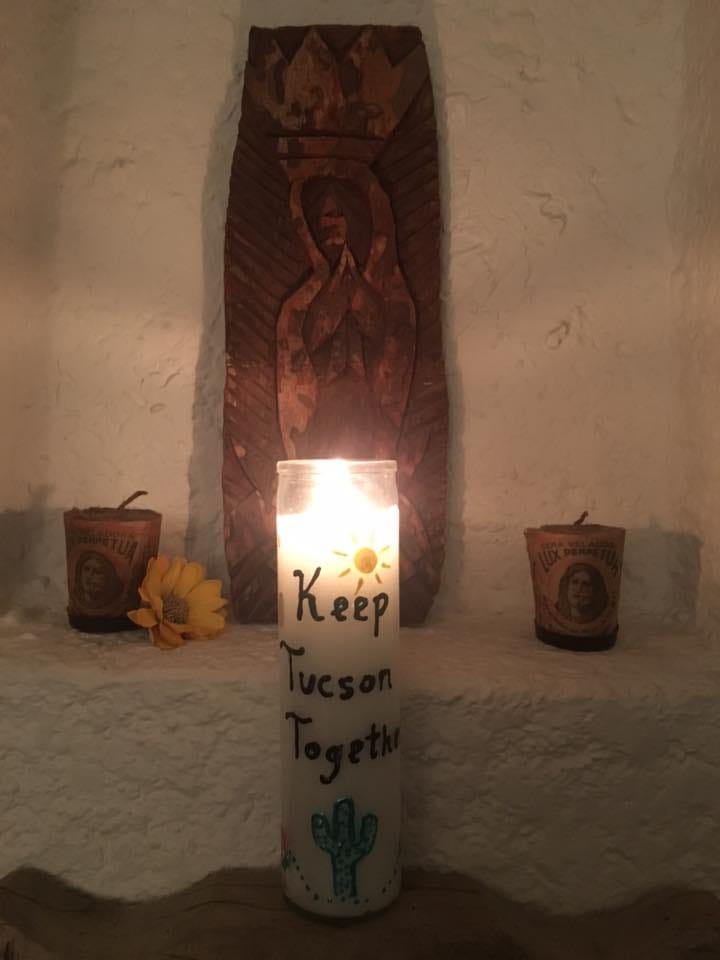
El Tiradito shrine in Tucson, Arizona in 2017. (Photo credit: Keep Tucson Together)
The Border Chronicle relies 100 percent on its readers and listeners to continue. Support independent border journalism and become a paid subscriber today for just $6 a month or $60 a year.
In this week's podcast, Melissa del Bosque and Geographer Dugan Meyer explain how the Border Chronicle's new project, Wall Watch, helps residents document and understand the massive construction project underway at the U.S.-Mexico border.
A vivid depiction of what has been happening during the last eight weeks of resistance against border wall construction in southern Arizona’s San Rafael Valley.
Wall Watch combines geospatial mapping, archival research, and community participation to provide the public with an accurate, continually updated record of border wall construction along nearly 2,000 miles of the international border.
Worried about the future of democracy in the United States? Look to Indigenous histories; they have much to teach us about the struggle between liberty and empire.